Could America Leave NATO?
A documentary concept mapping the legal, military, diplomatic, and economic consequences of a major alliance rupture.
Documentary desk
Visual investigations built around context, systems, and consequences—not spectacle for its own sake.
3previews shown
No previews match this filter.
A documentary concept mapping the legal, military, diplomatic, and economic consequences of a major alliance rupture.
A proposed documentary asking whether civilization should prioritize Earth systems, energy, and nearer-space infrastructure.
A Volume IV documentary concept about the human systems behind automation—compute, energy, education, care, maintenance, and the judgment required to turn technical possibility into usable capability.
Forthcoming book projects
Meet the four planned books behind Independent Observer. Together they move from the discipline of building a record, to the organization of power, to the distribution of social costs, and finally to the conditions that let technology become shared human capability. Explore a title below to read its public volume brief and follow the research question as it develops.

Volume I
The method book of the series: a practical account of observation, evidence, public memory, and democratic capacity. It follows how a claim becomes accountable—what was seen, which sources support it, what context or contradiction is missing, and how readers can correct the record.
Read the public volume brief →
Volume II
The power book: a study of sovereignty, institutions, migration, representation, enforcement, and the arrangements beneath formal democracy. It asks who can set the agenda, whose membership is recognized, and how power becomes usable—or remains only constitutional language.
Read the public volume brief →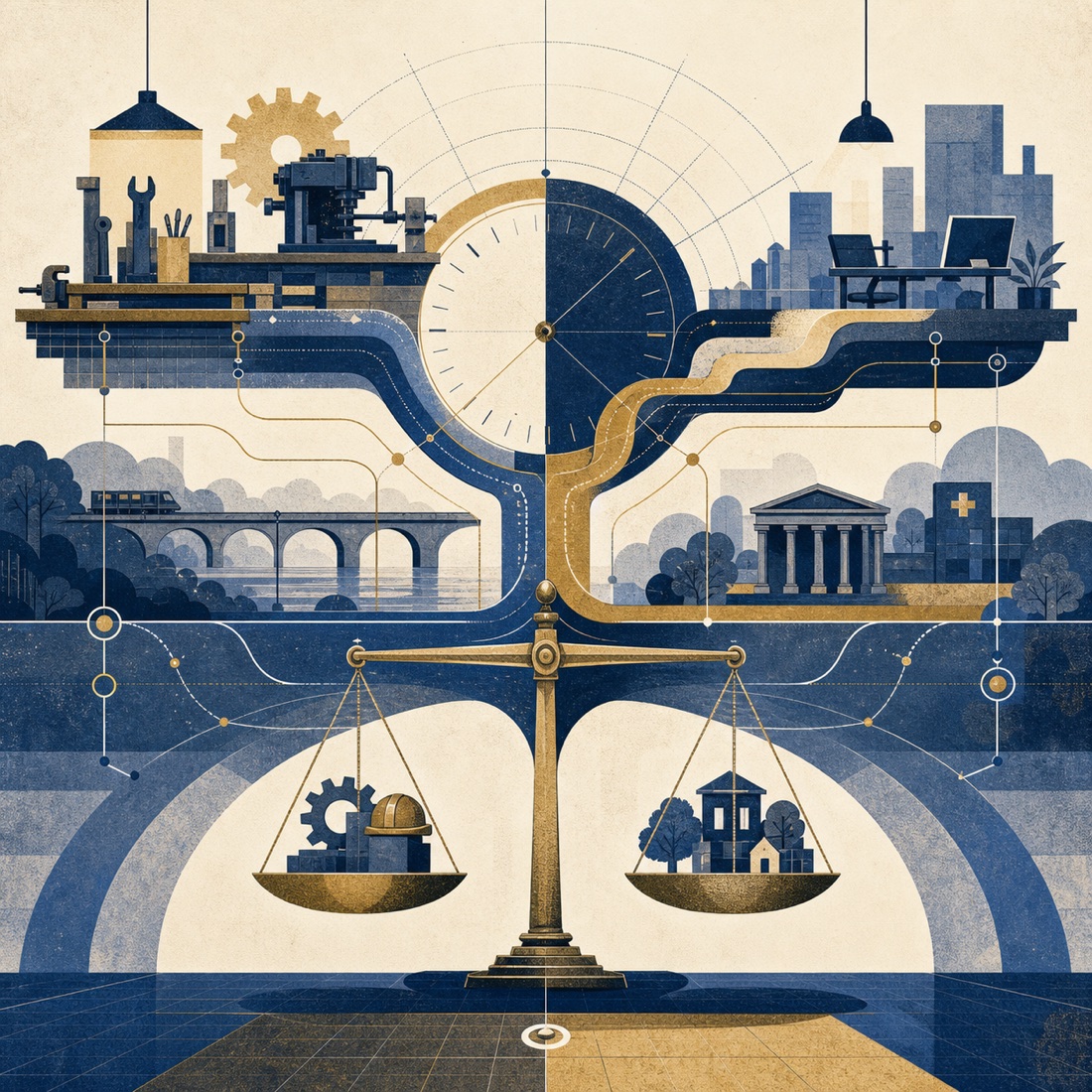
Volume III
The social-citizenship book: an inquiry into work, time, taxation, welfare, licensing, health, and economic security. It traces who carries the cost of economic change and whether public systems restore capacity or manage people through constrained choices.
Read the public volume brief →
Volume IV
The capability book: a forward-looking study of AI, science, infrastructure, energy, intimacy, education, care, and human adaptation. It asks what must be understood, maintained, financed, and governed before technology becomes usable human capability rather than a new source of dependence.
Read the public volume brief →Four-volume research programme
Documentary treatment follows the research spine. The papers below have author-controlled preprints matched to the reviewed project map; they remain working material while each volume undergoes continuing source, overlap, rights, and author review.
Democratic capacity
Volume I is the method anchor for the Independent Observer series. It is about how a public claim becomes believable: what was observed, which sources support it, what context or contradiction is missing, how interpretation becomes argument, and how uncertainty is recorded. It brings law, labor, media, history, public memory, and democratic practice into one framework so readers can follow not only a conclusion but the path that produced it. Its central question is whether people can use and correct their institutions in practice, not merely whether those institutions are formally legitimate. The volume represents disciplined observation before judgment and is intended to establish the evidence, memory, and accountability standards used by the later volumes. It remains a book roadmap in editorial development, not a finished publication.
Research state: In editorial development; public papers remain under revision and verification.
Leading public signals in this volume
Automation, Labor & Democratic Capacity
Method & Democratic Capacity
Sovereignty and interdependence
Volume II is the power inquiry of the Independent Observer series: it studies how authority can remain formally democratic while becoming materially managed. Its research map brings together four families—democracy, institutions, and party power; immigration, citizenship, and border; civil rights, the carceral state, and legal power; and empire, geopolitics, and sovereignty. Across those families, the volume asks who can set the agenda, who is exposed to enforcement, whose membership is recognized, which definitions make a statistic meaningful, and how capital, technology, security, labor, markets, and alliances shape practical sovereignty. It represents the inquiry beneath constitutional language, party rotation, and national claims of independence: the operating arrangements that narrow or expand usable public power. This remains a concept-stage catalogue entry, not a finished publication.
Research state: Concept preview; public papers remain under revision and verification.
Leading public signals in this volume
Demography & Migration
Democracy, Citizenship & Voting
Work and social citizenship
A concept-stage account of Managed Decline: how the Western industrial order moved from steel mills, mass production, and stable wage institutions toward screen-based, service, platform, and data work—and how that transition redistributes time, security, and economic opportunity. Volume III studies labor markets, licensing, welfare, taxation, health systems, and public visibility, asking whether administrative systems restore social citizenship or manage constrained choices. Its research map connects selected paper records including The Wardhan Tax Doctrine and From Vietnam to Terry v. Ohio: Investing in Human Failure vs. Human Potential with bounded working-paper directions such as From Steel to Screens and Welfare, Wealthfare, and Social Control in Advanced Democracies. These are research directions and reading links, not a claim that every manuscript is a released publication.
Research state: Concept preview; public papers remain under revision and verification.
Leading public signals in this volume
Political Economy & Tax
Conflict, Demography & Social Visibility
AI and human capability
A concept-stage capability inquiry into how technological change becomes usable human capacity. Volume IV follows AI, automation, scientific infrastructure, energy, quantum computing, medical technology, neuroprosthetics, education, intimacy, and human evolution. It asks what must be understood, maintained, financed, and governed before a new tool can be called progress: who owns the compute and data, who can repair the systems, who receives training and care, which claims survive evidence review, and how institutions protect human agency when technology becomes opaque. The volume represents the material and social conditions of adaptation—from the energy and semiconductor base of advanced computation to the embodied, cognitive, and civic capabilities that let people use it. It remains an editorial-development catalogue entry, not a finished publication.
Research state: In editorial development; public papers remain under revision and verification.
Leading public signals in this volume
Quantum Computing & Scientific Capacity
Technology & Intimacy
Each project is intended to begin with a source dossier and an explicit claim map. The script, visual plan, narration, and distribution package should follow from that research, not substitute for it.